Assistive technology · 2025
Assistive glasses
A prototype to assist eyelid movement using a pulley-based mechanism.
Problem
Patients with paralyzed eyelids may not be able to blink normally, which can be uncomfortable and cause eye damage. Conventional approaches can introduce additional challenges – blinking with magnetic weights is slow and they can further ptosis over time; permanent eyelid closure is nonfunctional and aesthetically undesirable for patients seeking a more natural appearance.
Design & Fabrication
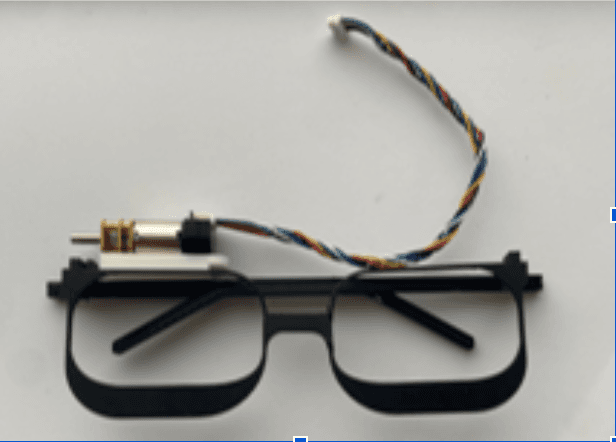
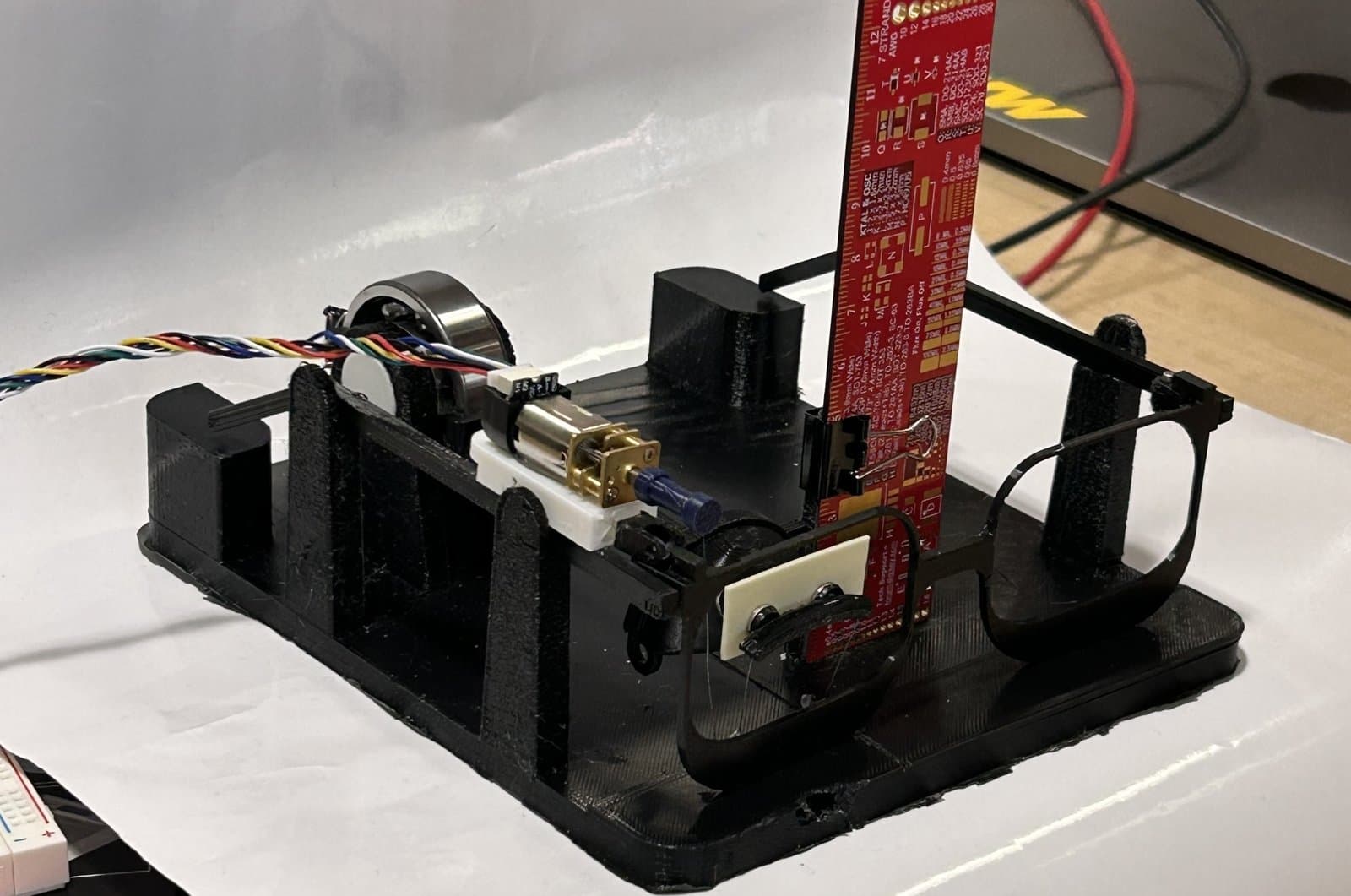
I developed a prototype for assistive glasses that mechanically support eyelid movement. This design uses a pulley-based mechanical system coupled with a small motor to generate the eyelid-close movement. An Arduino-based control system operated the motor, allowing the mechanism to provide consistent, repeatable assistance with blinking that could be customized based on patient needs.
The mechanical and electronic systems were designed to fit within a wearable glasses frame, while maintaining the functionality needed to assist eyelid movement.
Impact
The project produced a prototype for wearable, mechanically actuated glasses that provide blinking assistance, that provided a more aesthetic alternative to permanent eyelid closure and a less potentially harmful solution like eyelid weights. By combining a pulley mechanism, motor actuation, and motor control, the design demonstrated how a compact mechatronic system could be effective for a human-centered application.
Tools/Methods
CAD, 3D printing, mechanical design, pulley mechanisms, prototyping, patient-centered design